AI and critical infrastructure in Norway: the Security Act and NSM
Oil, gas, power grids: in Norway, operational data can touch national security. How to govern generative AI under the sikkerhetsloven and NSM guidance.

North Sea platforms, power grids, hydropower dams, gas pipelines to the continent: Norway runs infrastructure that much of Europe depends on. The engineers and operators who keep it running use generative AI tools like everyone else, to draft, summarise and analyse.
In this sector, a leak is not just a compliance problem. A process diagram, a maintenance plan or a vulnerability report can interest hostile actors. Here is how Norway's Security Act and NSM guidance apply to the use of AI.
The National Security Act in brief
The National Security Act (sikkerhetsloven) of 2018 came into force on 1 January 2019. It aims to protect national security interests, including fundamental national functions (grunnleggende nasjonale funksjoner) and objects and infrastructure worthy of protection.
It applies to public bodies and to private companies brought within its scope, in particular those handling classified information or controlling infrastructure deemed critical. The national security authority, Nasjonal sikkerhetsmyndighet (NSM), oversees its implementation and publishes practical guidance.
Classified information follows a simple rule: it may only be processed on systems approved for that level. A public AI service is obviously not one of them.
The real risk: sensitive but unclassified data
In practice, most documents in an energy company are not classified. They are still sensitive. And they are exactly what most often ends up in a chatbot:
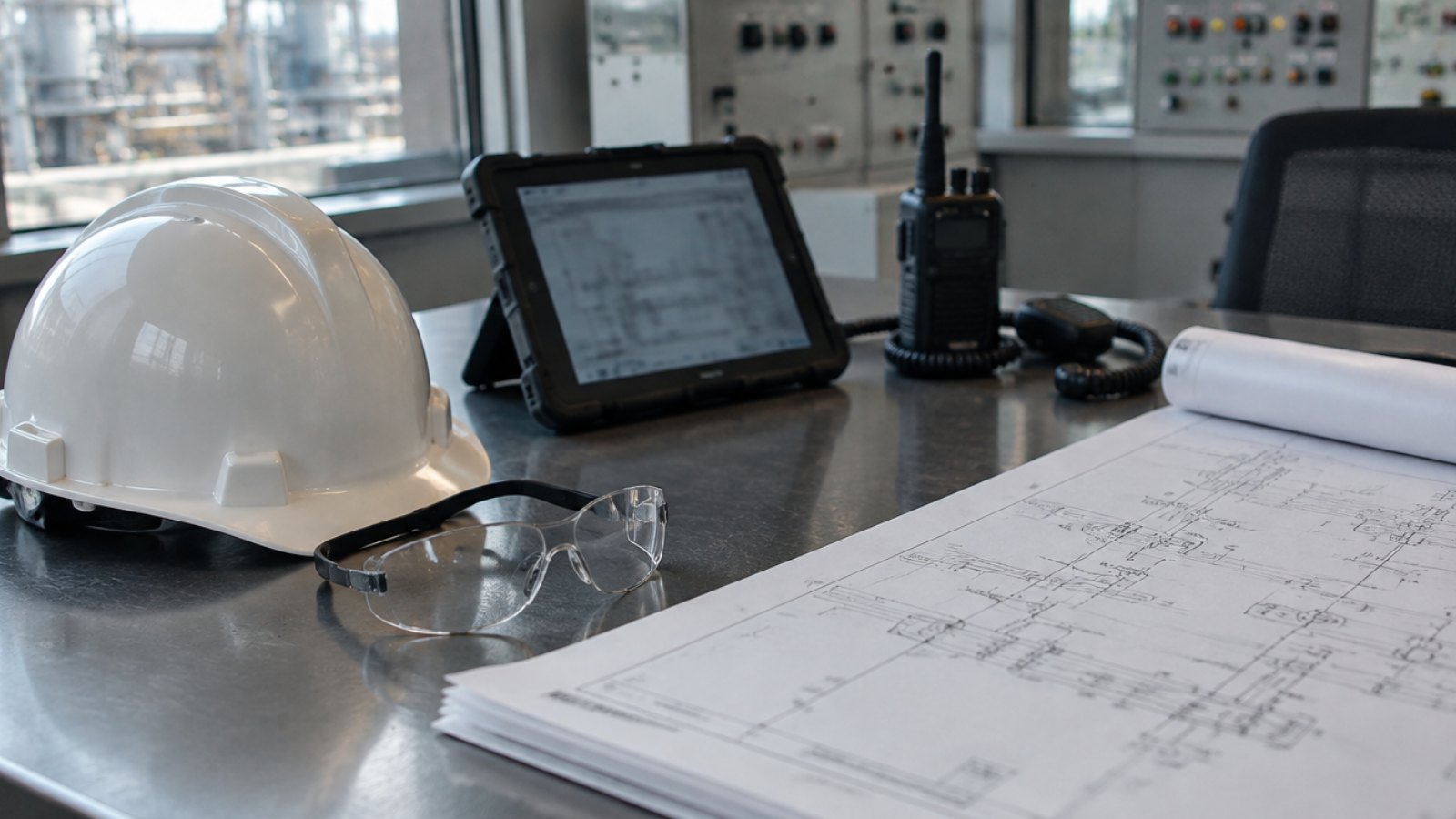
piping and instrumentation diagrams, facility layouts;
industrial control system configurations and network addresses;
maintenance plans, incident reports and risk analyses;
emergency plans and on-call contact lists;
contracts and supplier data.
Taken one by one, these items look harmless. Put together, they can draw a precise map of a facility's weak points. This is the aggregation problem, well known to security specialists: the whole is worth more than each piece.
Take a common example. After an unplanned shutdown, a maintenance engineer has to write a report. They paste alarm logs, equipment tags and the names of on-call colleagues into an assistant to get a clean text. In a few seconds, details about how a critical facility works have left the company.
What NSM recommends
NSM's basic principles for ICT security (grunnprinsipper for IKT-sikkerhet) do not name any particular AI tool. Yet they set the framework that applies: know what information you hold, control data flows, manage external services, detect deviations and be able to respond.
Applied to generative AI, these principles lead to a clear conclusion. An organisation must know which AI services its teams use, what is sent to them and in which country that data is processed.
These principles also apply along the supply chain. Much of the engineering and maintenance work is handed to contractors, whose use of AI often sits outside the operator's view.
The sovereignty question
For a critical infrastructure operator, where data is processed matters as much as what it contains. A service hosted outside the European Economic Area may be subject to other laws on data access. Many Norwegian players therefore prefer offerings hosted in Europe or in their own environments.
Our article on sovereign AI for European CISOs compares these options. But no hosting choice solves the problem of consumer tools used on the side.
Personal data is still in play
On-call lists, accident reports and contractor assessments also contain personal data. Processing it falls under GDPR, which applies in Norway through the European Economic Area, and under the supervision of Datatilsynet. Our first article on Norway looks at this from the human side: workplace trust and oversharing with AI.
A four step approach
Map sensitive information: drawings, configurations, security reports, supplier data.
Approve a limited number of AI tools, with suitable hosting and contracts.
Check at the moment of sending, on workstations, including for offshore crews and contractors.
Document incidents for internal audits and dialogue with the authorities.
Our 90-day AI DLP rollout playbook explains how to put these steps in place without disrupting operations.
Where ZeusLock fits
ZeusLock runs on workstations and browsers. It detects in prompts and files the items you define as sensitive: equipment tags, internal IP addresses, facility names, personal data. Depending on the rule, it warns, blocks or replaces the data with a realistic value of the same format. Every incident is logged, giving the security team a concrete view of the flows towards AI.
Rules can be tailored by site or by role: an engineering team does not have the same needs as a purchasing department. And because the check happens on the device, it follows the laptops of teams who move between onshore offices and offshore installations.
Summary
For Norwegian energy and critical infrastructure, generative AI is a useful tool, but the information it handles can touch on national security. The sikkerhetsloven and NSM's principles set the framework. What remains is to apply it at the exact moment an engineer pastes a document into an assistant.
Want to see how ZeusLock protects your operational data inside AI tools? Book a demo.
Protect your data from AI leaks
See ZeusLock stop sensitive data before it reaches ChatGPT, Claude, Gemini and more, in a 30-minute demo.