Generative AI in West Africa: How to Protect Your Sensitive Data
Senegal, Côte d'Ivoire, Benin: every prompt sent to ChatGPT can become an unlawful data transfer. Legal framework, real risks and how AI DLP helps.

In Dakar, Abidjan and Cotonou, generative AI reached the office faster than security policies did. A customer advisor pastes a bank statement into ChatGPT to draft a reply. A legal counsel asks an AI assistant to summarize a contract with a public partner. A developer sends a configuration file to Copilot to fix a bug. Each time, sensitive data leaves the company, often to servers located outside the continent.
For West African businesses, this is not only a technical issue. It is a matter of compliance, sovereignty and customer trust. This article covers the legal framework, the real risks and how to protect your data without slowing down AI adoption.
Fast adoption, mostly invisible
In banks, telecom operators, insurers and public administrations across the region, generative AI is first adopted individually. Employees use personal accounts, in their browser or on their phone, without IT approval. This is what we call Shadow AI.
The tool itself is not the problem. The problem is what people give it: customer phone numbers, ID documents, mobile money data, health records, salaries, source code, API credentials. Once sent in a prompt, this information is completely out of the company's control. We covered this hidden cost in The Real Cost of Shadow AI in 2026.
What the law says in West Africa
Contrary to a common belief, the region is not a legal vacuum. Several countries have had strong personal data laws for years, with active supervisory authorities.
Senegal: Law No. 2008-12 of 25 January 2008 governs the processing of personal data. The Commission de protection des Données Personnelles (CDP) enforces it, and a revision is under way to better address AI use cases.
Côte d'Ivoire: Law No. 2013-450 of 19 June 2013 on personal data protection is enforced by ARTCI.
Benin: the Digital Code (Law No. 2017-20) dedicates an entire book to personal data protection, supervised by APDP.
Regional level: the 2010 ECOWAS Supplementary Act on personal data protection sets a common baseline, and the African Union Malabo Convention entered into force in June 2023.
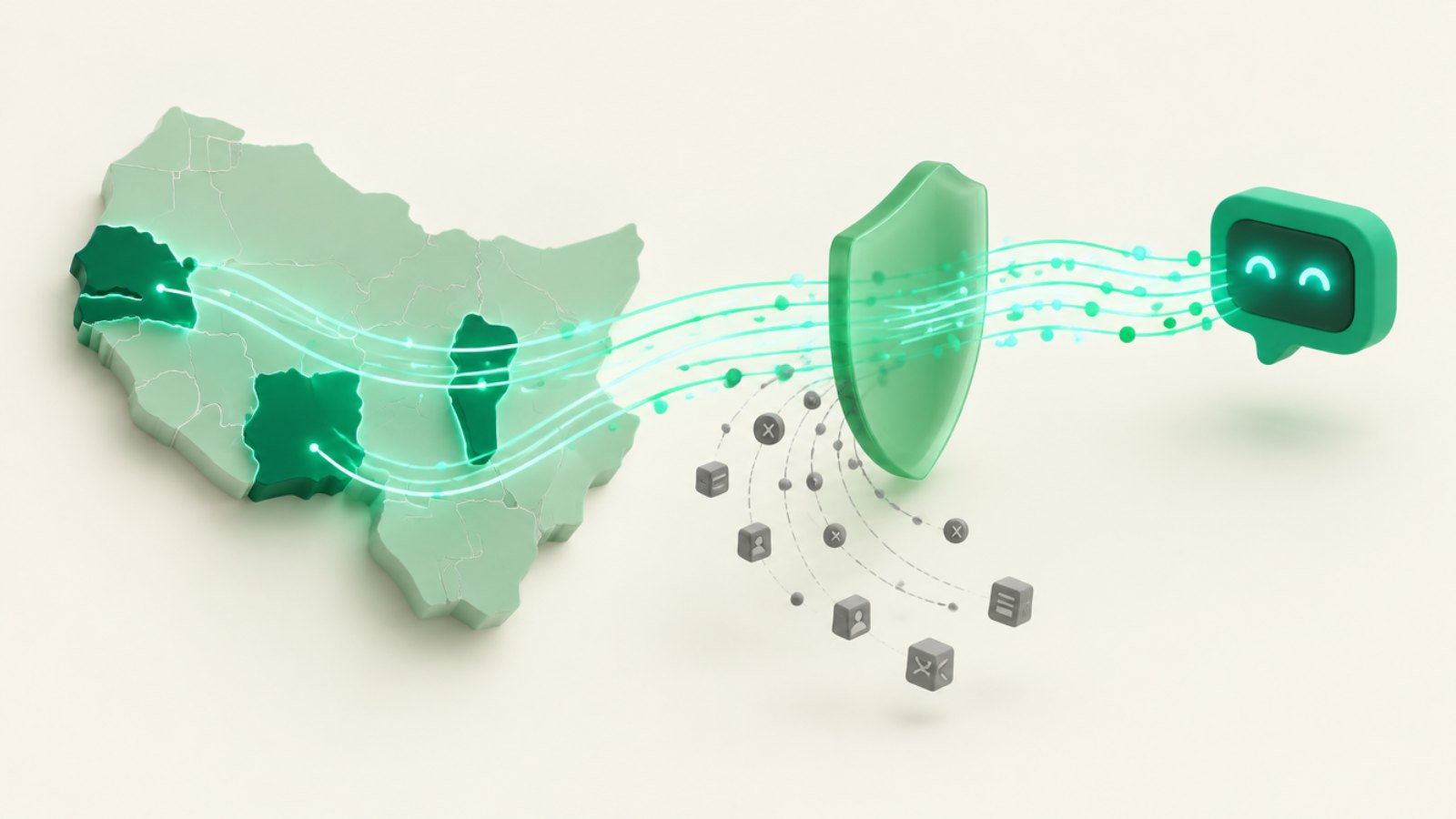
These laws share one point that matters for AI: they strictly regulate transfers of data to third countries. As a rule, a transfer is only allowed if the destination country offers an adequate level of protection, or with the supervisory authority's approval. When an employee pastes customer data into an AI assistant hosted in the United States, that is exactly what happens, with no formality at all.
Why traditional security tools fall short
Many companies in the region have invested in firewalls, antivirus and sometimes email DLP. These tools were built for a different world. They watch attachments and file transfers, not text typed or pasted into a chat window. We explain this gap in Why Email DLP Fails on ChatGPT.
Simply blocking AI tools is not a lasting answer either. Teams work around the ban with their phones, and the company loses both visibility and productivity gains.
The most exposed data in the region
Some data categories show up again and again in AI related leaks in West Africa:
Phone numbers and mobile money identifiers, everywhere in customer conversations.
ECOWAS national ID card and passport numbers, collected during account opening.
Financial data: statements, IBANs, transaction histories.
Health data, especially in insurance and mutual health organizations.
Technical secrets: API keys, passwords, connection strings.
A pragmatic approach: AI DLP
AI Data Loss Prevention acts at the exact moment data heads to the AI. In practice, a solution like ZeusLock:
Detects sensitive data in prompts and files sent to AI assistants, including formats specific to the region.
Anonymizes that data automatically before it is sent, keeping its format so the AI answer stays useful. See our article on format-preserving anonymization.
Blocks the most critical submissions according to your policies.
Logs every incident to provide evidence to the CDP, ARTCI or APDP during an audit.
Employees keep using AI. The company keeps control of its data.
Where to start
You do not need an eighteen month project. A three step approach works well:
Observe for two to four weeks to measure which tools are used and which data flows to them.
Coach teams by showing concrete alerts at the moment the risk appears.
Protect by gradually turning on anonymization, then blocking for the most sensitive data.
Our 90-day rollout playbook walks through every step.
Key takeaways
Generative AI is a real opportunity for West African businesses. But every prompt can become an unauthorized data transfer under Senegalese, Ivorian or Beninese law. Companies that address this now win twice: they secure their data and they unlock AI use with confidence.
Want to know which sensitive data is already flowing to AI in your organization? Request a ZeusLock demo.
Protect your data from AI leaks
See ZeusLock stop sensitive data before it reaches ChatGPT, Claude, Gemini and more, in a 30-minute demo.